“San Huang Wu Di” Three Sovereigns and Five Emperors is a term used in Chinese mythology and history to refer to legendary rulers who lived in ancient China before the Xia Dynasty. The age of the three Sovereigns was earlier than the Five Emperors.
Based on “Fengsu Tongyi”, Comprehensive Meaning of Customs and Mores, The Three Sovereigns were Fuxi, Nuwa, and Shennong.
Fuxi and Nuwa are the ancestors of Chinese myths. Their appearance marked the beginning of Chinese civilization.
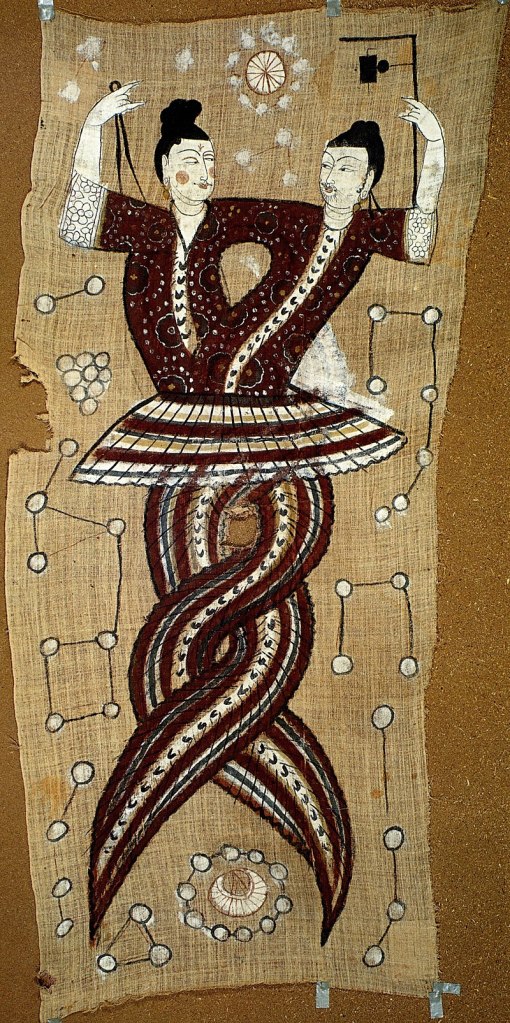
Fuxi was revered as the head of the three emperors.
Fuxi’s mother was a beautiful woman from a country called HuaXu. She came to the legendary territory of The God of Thunder, called “Lei Ze” and saw a huge footprint on the ground. Out of curiosity, she stepped on it and got pregnant. After twelve years of pregnancy, she gave birth to a son, who had the body of a snake and the head of a man. The boy is called Fuxi.
Legend says Fuxi created Ba Gua, the eight Diagrams. One day, there was a monster in the river. The monster looked like a dragon but not a dragon and looked like a horse but not a horse, called Dragon Horse. There were patterns on its back and no one knew the meaning of it. Later on, Fuxi saw a white turtle and noticed the pattern on its back. He suddenly realized the meaning of those two patterns and understood that the universe’s law of change is only yin and yang. Based on it. Fuxi drew eight patterns, called Ba Gua, the Eight Diagrams. Ba Gua, The Eight Diagrams, becomes the origin of Chinese culture.
Nuwa is the mother of the Chinese nation and a symbol of female worship in primitive matrilineal society.
According to legend, Nuwa used loess and imitated herself to create human beings and human society.
There is also a legend called Nuwa mended the sky. Once there was a catastrophic disaster occurred in the natural world, the sky collapsed and the earth fell, the ocean poured into the land and caused floods. The raptors and beasts came out to harm the people. She smelted five-color stones to mend the sky, and cut off the four legs of a ten-thousand-year-old tortoise to support the sky pillar in all four directions.
In addition, Nuwa made a musical instrument ShengHuang. She used it to bring human beings back to life from the floods, and encourage them to enjoy life and have babies. She established a marriage system for human beings, enabling men and women to marry each other and reproduce offspring. So Chinese people also regarded her as the goddess of music and the goddess of marriage.
“Shennong”, translated as “Divine Farmer”, was a mythological ruler known as Yan Emperor.
According to the legend, Shennong had the head of a bull and the body of a man. He tasted all kinds of herbs and developed herbal medicines to treat diseases. He was the innovator of traditional Chinese medicine, as well as the founder of agriculture.
He taught people the way of agriculture and invented the farming tool Lei Si and grew five grains. He led people to produce pottery and cooking utensils. He also taught people how to dig wells and reclaim wasteland to grow food crops. In order to cultivate crops according to seasons, he also set up the calendar, which is the 24 solar terms. By Taoism, Yan Emperor is revered as the Great Emperor of Five Grains Shennong.
Yan Emperor’s tribe later formed an alliance with “Huangdi” Yellow Emperor tribe. Chinese call themselves the descendants of Yan Emperor and Yellow Emperor, which is “Yan Huang Zi Sun” regard they are the first human ancestors of the Chinese people, which has become the spiritual motivation for the unity of the Chinese nation.
Depending on the source, there are many variations of who classifies as the Three Sovereigns. Some may say the Three Sovereigns were Fuxi, Shennong, and Suiren. Suiren is considered the fire ancestor, who used wooden fire drill to create fire and used it for cooking. Some may say the Three Sovereigns were Fuxi, Shennong, and Yellow Emperor.
 Archaeologist Dads